

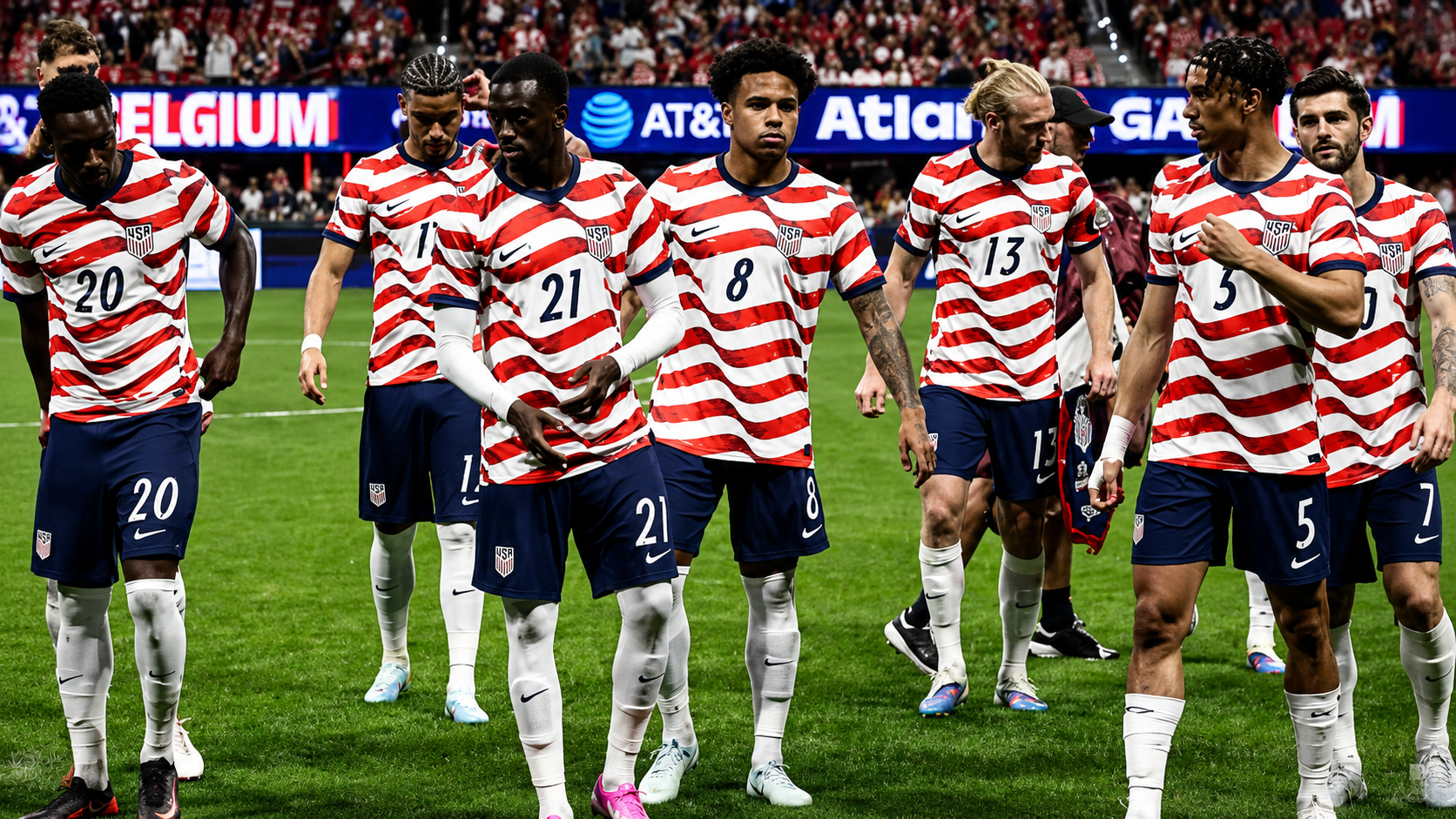
The United States Men’s National Team (USMNT) is going into the 2026 World Cup Cycle with a worry. Defensive consistency has yet to be determined. Facing quality competition has brought some cracks to the surface in terms of both structure and may hinder development in a tournament environment. It’s not limited to just a few mistakes. It highlights wider issues of organisational, transition management, and “under pressure” decision making.
Defensive Record Trends
The USMNT gave up just one goal in the three group stage games in the 2022 World Cup. Some of the best defensive records in that era. But the Round of 16 defeat to the Netherlands revealed some terrible flaws. The team gave up three goals, none on their own, but as a result of well-formed attacking play.
Data from after 2022 is definitely inconsistent. The United States has allowed an average of more than 1.5 goals per match against the top-15 FIFA ranked teams. This is higher than the average of teams in the semifinals (which is around 1.2 goals scored against them per game). The pattern suggests that defensive stability is a huge concern in the presence of quality opposition.
Transition Defense
Defensive transition is always one of the recurring problems. Recovering shape is frequently postponed when possession is lost. This provides space between midfield and defense in front of fast attacking teams. Players can move around the middle without pressure from opponents.
A high proportion of goals conceded in recent games have been within 10-15 seconds of losing possession. This isn’t necessarily about individual errors, but rather it is indicative of poor spacing and reaction speed. Transition defense is key at the World Cup level. Resetting quickly is always rewarded, and teams that don’t do so are often penalized.
Full-Back Positioning
The USMNT are a team that uses attacking full-backs to a great degree. This is good to have for attacking, but it does create exposure on the defense. If both full-backs come out at the same time the defence is open to wide counterattacks. These channels are targeted by opponents and cause center-backs to play in wide areas. This makes it more difficult to find the ball in the center and provides room for the penalty area. This is the way several recent goals have gone that have been conceded. The question of balancing attacking contribution with defensive responsibility remains a puzzle.
Center-Back Coordination
Top teams have tried to exploit the center-back duo, but it has not been a consistent partnership. Main problems are due to late tracking of runners, lack of protection and communication in the penalty area. Positioning is generally static in the structured defending phases. But, in dynamic motion, coordination becomes very poor very quickly. Timed running and effective passing movements are essential for top international teams and breakdown defence is simple without coordination. This is especially important in knockout games, where one mistake in defense can mean one more man out of the game.
Set-Piece Vulnerability
Set pieces are still an area of concern. Defensive marking is not the main problem but has been inconsistent. Both zonal and man-marking has been employed and there has been some variation in execution. High-quality chances have been created from corners and indirect free kicks from opponents. Set pieces make up a lot of goals at the World Cup. The teams that get deep in the tournament tend to keep their defense at a tight pace in these situations. Not a consistent level has been achieved with the USMNT.
Goalkeeper Dependency
The goalkeeper is relied upon in the defensive system to fill in gaps. Though shot-stopping has been effective, this is not going to be enough when facing formidable opponents. With high shot volume, it is likely that the goalkeeper will allow a shot to go in, even if they are good. Teams that reach the semi-finals normally do not shoot more than 4 shots on target a game. In other recent games against tough teams, the United States has surpassed this mark. Recovery saves are not needed to reduce defensive exposure.
Midfield Protection
Midfield is also connected with defensive issues. The midfield can become too wide when changing the play from defence to attack and vice versa. Central areas left exposed after holding midfielders cover wide areas. This opens up opportunity for opponents to run directly through the center. Good defense teams have short lines. Over the past few seasons, the USMNT has had a difficult time keeping it going. Defensive stability will be affected by the improvement of midfield screening.
Tactical Adjustments Needed
Before the start of the tournament, a few necessary structural changes are needed, to answer these questions. Coaching staff need to ensure that full-backs are coached to move in a more controlled manner to limit exposure in the wide areas and to transition quicker to ensure that there are fewer quick counterattacks. Also, the back centre partnership should be stable so the team can grow and improve on the field coordination and better overall compactness between the midfield and defence. Changes are not simply aimed at changing the people but systemically restructuring.
How did the game affect the World Cup mood?What was the impact on the world cup mood?
Defensive success is a major determining factor in tournament success. The average of the past five World Cups was less than 1.3 goals per match for all the semifinalists. If they continue their performance, the USMNT doesn’t reach this standard against the best teams. Outside of the quarterfinal round, it is unlikely that they will advance without improvement. There’s a greater chance of being eliminated in knockout rounds when consistency isn’t a factor.
The USMNT can do the individual thing, but the defensive build-up is an issue. Problems are quantifiable and reproducible in recent performances. These issues need to be addressed as the World Cup draws near in 2026. Success will be judged by the number of goals conceded, the control of attack/defence transitions and the discipline of the defence against high level opposition. Otherwise the disparity between the United States and the best teams will be seen at the highest level.





Leave a Reply