

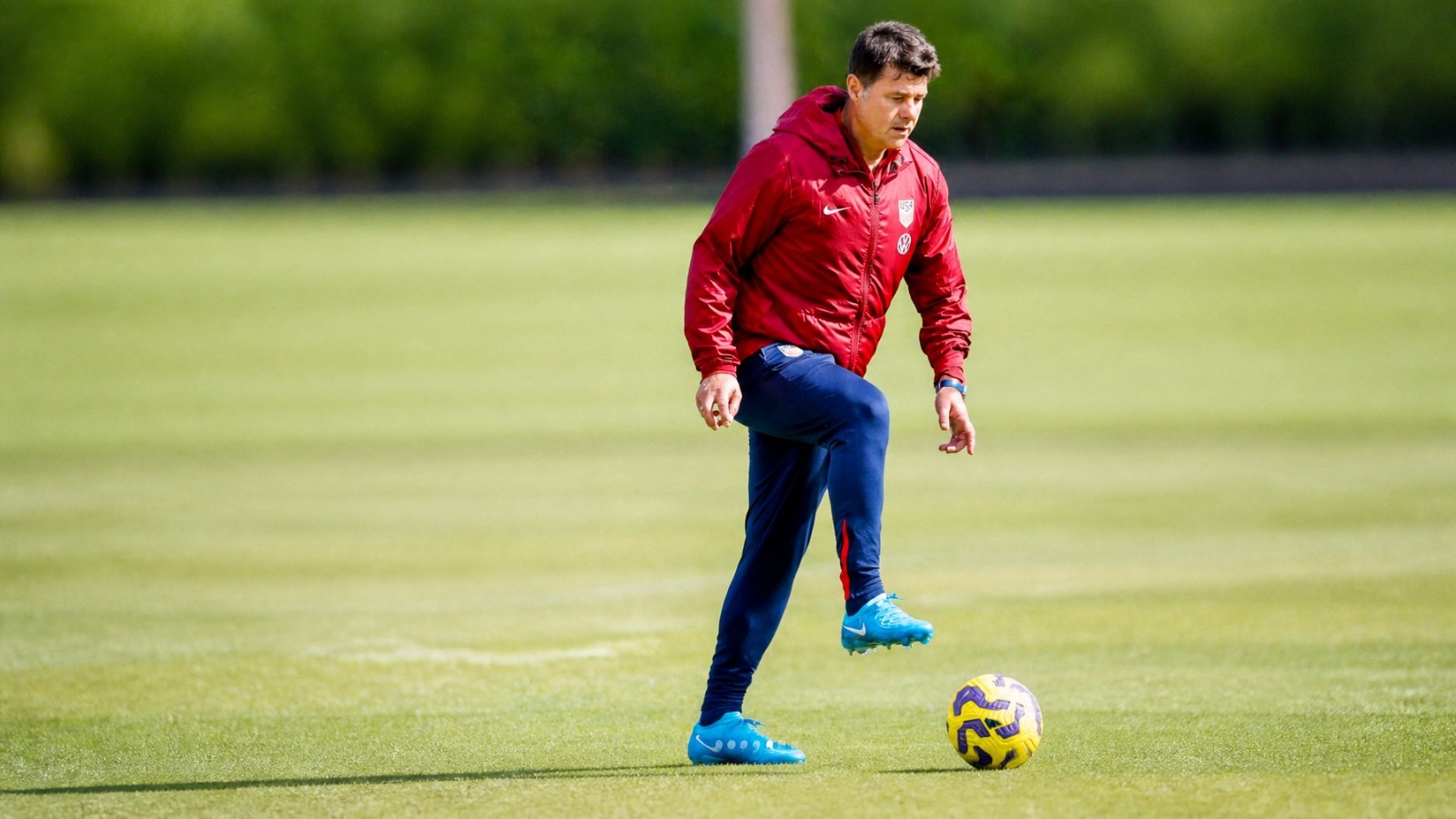
After the victories over Belgium and Portugal, the United States men’s national team had high hopes for March 2026 but their own concerns have been raised. A 5-2 loss followed by a 2-0 defeat revealed weaknesses that hadn’t been thoroughly tested against lesser competition. These matches were no walkovers. They identified weaknesses in defense, midfield control and attacking efficiency.
Now the spotlight is on Mauricio Pochettino’s reaction as the World cup is coming. It’s a direct question. Are the team’s skills developing in terms of time, or is there a recurring issue?
March Results
The two games offer a good snapshot of the stats. In both matches the USMNT would allow 7 goals while only getting 2. That shows how wide the gap is between the two and their ability to attack and defend.
The Belgian game was the more troubling one. They played well at first but allowed five goals, indicating a lack of focus and organization over time. Defensive form didn’t improve quite as much against Portugal, but still they were unable to score.
One other trend is prominent. In line with the opposition of the top European teams, the US has not been able to handle it consistently. The team has allowed more than 20 goals in games they’ve faced in recent times and have scored less than 10 goals. This disparity is indicative of the efficiency and game management differences at elite level.
Defensive Issues
The most troubling defensive issue continues to be the defensive structure. They were unable to secure wide runners between midfield and defence against Belgium. This enabled rapid-fire attacks which resulted in several goals.
Compactness improved against Portugal. The defenders were not able to spread out as much and didn’t have as many direct breakdowns. The system was yet vulnerable during transitions, however.
One of the main problems is that it relies on certain players. If there is no natural DMF then the line is very weak in front of the back line. This increases the amount of time that defenders have to be in one-on-one situations. Wherever it happens, small positional errors result in goals, at international level. The USMNT is still getting used to that new reality.
Midfield Stability
Pochettino’s play is all about the midfield balance. His strategy is one of controlled transition, quick recovery and pressing. That balance was not consistent in March. Multiple midfield combinations were used, this caused a lack of cohesion. In the last year over 50 players have been tested and only a few have played regular minutes. This kind of rotation impacts the comprehension of players.
The midfield was lacking of stability and the team had a hard time controlling the tempo. Opponents had more freedom of movement in center areas. It is not a quality problem. They have good midfielders in the team. The problem is continuity. Partnerships should be practiced repeatedly to be effective, particularly with high intensity teams.
Attacking Efficiency
The attacking output is still less than required standards. Two goals in two games is not sufficient at this level and both were in one game. It was a good time for opportunities to be made. The US generated more chances in the first half and had more the ball movement in the final third as they faced Portugal. But the finish was not even.
The difference in elite level is in efficiency. The better teams convert a greater percentage of chances and the US must get several chances to score. This puts the defense under pressure, since the opportunities frequently provide opportunities for counterattacks. The system to attack is functional and the attack is not always consistent.
Signs Of Progress
There is definitely a definite improvement given the outcome. Portugal’s defensive discipline was not like Belgium’s in the Portugal match. The team stayed together for longer and didn’t break down again and again.
Pochettino has opted for a few changes too. Various systems have been employed to arrive at a balance of roles for players.Role assignments have been tested; various systems have been applied. This means that people are trying to work out a solution to the problem and not just going through the motions.
Other pluses include intensity. The team did well in pressing phases, a style of play that Pochettino prefers. But improvement in structure should lead to results. When this happens, it’s not a matter of performance.
Squad Rotation
Heavy rotation has been a major characteristic of this cycle. Pochettino has tried many, many players out and this is good to know he has depth, but not ready to make a squad.
Clearance is essential when playing football internationally. Teams with a strong start are often the ones that start with a well-established starting lineup and have clear roles. The USMNT is still working on that configuration.
Chemistry has been impacted by the frequent changes in midfield and defence. Hesitation in critical moments – players not yet accustomed to one another. Now it is time to decrease rotations. The emphasis needs to be taken from experimentation to stability.
Time Constraint
Time is the most difficult aspect. World Cup is around the corner and there are not many games left to make changes. International football teams don’t have long training sessions like club football teams do. Tactical changes should be easy to understand, easy to execute and repeatable.
This increases the importance of decision making. The coaching staff needs to be able to determine the best possible combination as rapidly as possible and not deviate from it. Any of these delays decreases the odds of establishing consistency prior to tournament.
Key Fixes
Priorities are well defined and action-oriented. Defensive line must improve their coordination, particularly in transitions. A good defensive midfielder and a consistent back four is necessary. Midfield combinations need to be strengthened. The choice of a core group, and keeping it consistent, will enhance control and communication.
Attacking efficiency needs to be improved. The team provides opportunities, but it’s decision-making in the final third that is lacking. It’s also important to have tactical clarity. The roles of players should be well defined and there should be minimal role movement between games.
Pochettino has made some steps forward, but these are not sufficient to solve the problems. The Portugal fixture proved to be a step up with some consistency except in the area of structure. The defense is somewhat more structured but still vulnerable. The midfield is good but unbalanced. The attack looks good but fails to convert.
The team is but not yet ready. The difference between top European teams and the USMNT remains in crucial instances. There’s still room to improve, but not much. The next few games will be the deciding factor as to whether these changes are sufficient to make them World Cup competitive.


Leave a Reply